Petrol and Diesel Price in Pakistan: Complete 2026 Guide Explained
Economy · Fuel · Pakistan · 2026
Figures reflect the latest officially notified petrol and diesel price in Pakistan as of early August 2026. Rates in Gilgit and Quetta run slightly higher due to transport costs. Since fuel rates here are revised on a fortnightly basis, always confirm the current figure with an official notification before making fuel-dependent business decisions.
The petrol and diesel price in Pakistan has become one of the most closely watched economic indicators in the country, and for good reason. It touches nearly every household, every business, and every sector of the economy — from the rickshaw driver in Multan to the logistics company moving goods between Karachi and Peshawar. Understanding how this rate is determined, why it moves the way it does, and what factors are likely to shape it going forward is essential for anyone trying to plan a monthly budget, run a transport business, or simply make sense of the news.
This guide takes a professional, structured look at the current petrol and diesel price in Pakistan, the mechanism behind it, the historical pattern of change, and the practical implications for ordinary consumers. Rather than treating it as a single abstract number, it’s worth breaking the topic down into its real components — global crude oil trends, currency movement, taxation, and domestic policy — because each of these plays a distinct role in shaping what you see posted at your local pump.
How the Petrol and Diesel Price Is Determined in Pakistan
Unlike some countries where fuel is sold at a fully deregulated market rate, the petrol and diesel price in Pakistan follows a regulated pricing formula overseen by the Oil and Gas Regulatory Authority. Every two weeks, the regulator calculates an updated rate based on the international price of crude oil and refined products, the prevailing exchange rate between the Pakistani rupee and the US dollar, freight and inland distribution costs, and applicable government levies such as the petroleum development levy and general sales tax. Once calculated, the new figure is notified and then implemented uniformly by the major oil marketing companies across the country.
This fortnightly cycle means the petrol and diesel price is never static for long. A sharp move in global oil markets, a weakening rupee, or a change in the government’s levy policy can all shift the rate within a single notification cycle. For businesses that depend heavily on fuel — public transport operators, freight companies, agricultural machinery operators — this fortnightly revision is one of the most important dates on their operational calendar.
The Role of International Crude Oil Prices
Since Pakistan imports the vast majority of its crude oil and refined petroleum products, the domestic petrol and diesel price is directly linked to international benchmark prices. When global crude oil prices rise, the import cost of refined fuel rises with it, and this is reflected in the next notification. Because Pakistan does not produce enough crude domestically to insulate its market from global swings, local rates effectively import global volatility along with the fuel itself.
The Impact of the Exchange Rate
Even when international oil prices stay flat, a weaker rupee against the US dollar can still push the petrol and diesel price higher, because all crude and refined product purchases are settled in dollars. This is one of the least visible but most consistent drivers of fuel costs in Pakistan — a currency depreciation of even a few rupees against the dollar can add a noticeable amount to the next cycle, independent of anything happening in oil markets themselves.
Taxes and Levies
A significant portion of the petrol and diesel price consumers pay at the pump is made up of government levies rather than the underlying cost of the fuel itself. The petroleum development levy, in particular, is a fixed per-litre charge that the government can adjust to meet revenue targets, and changes to this levy show up directly in what drivers pay. General sales tax, where applicable to specific products, adds a further layer on top. Understanding this breakdown helps explain why rates sometimes rise even when global oil markets are relatively calm — a policy-driven levy adjustment can move the numbers on its own.
Current Petrol and Diesel Price Snapshot
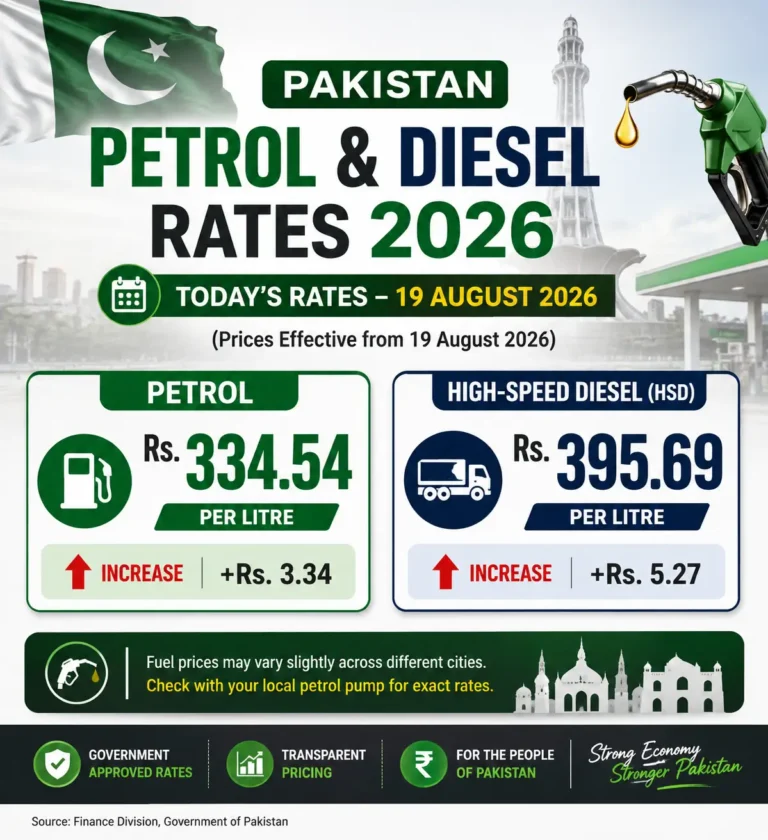
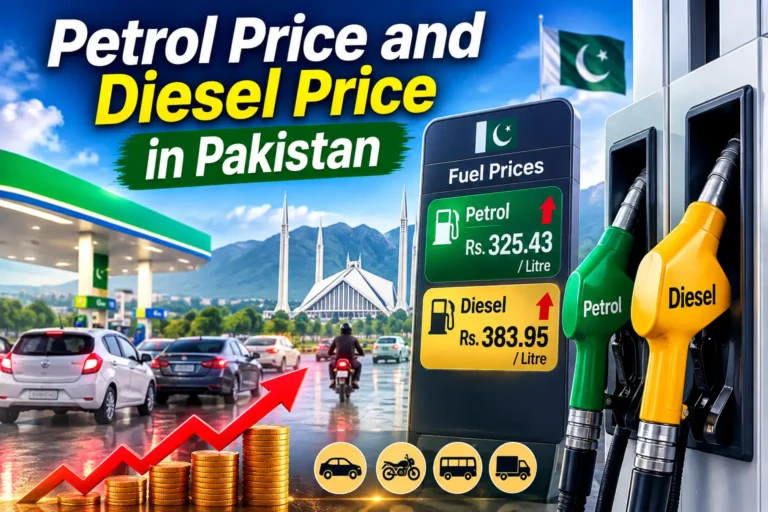
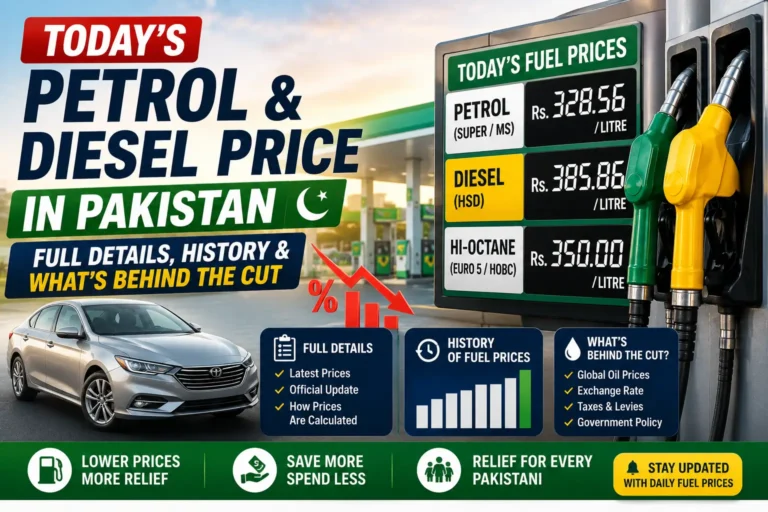
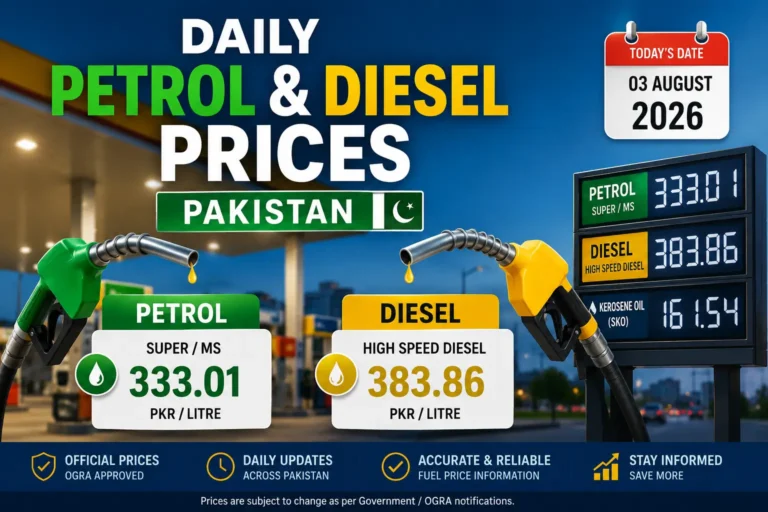
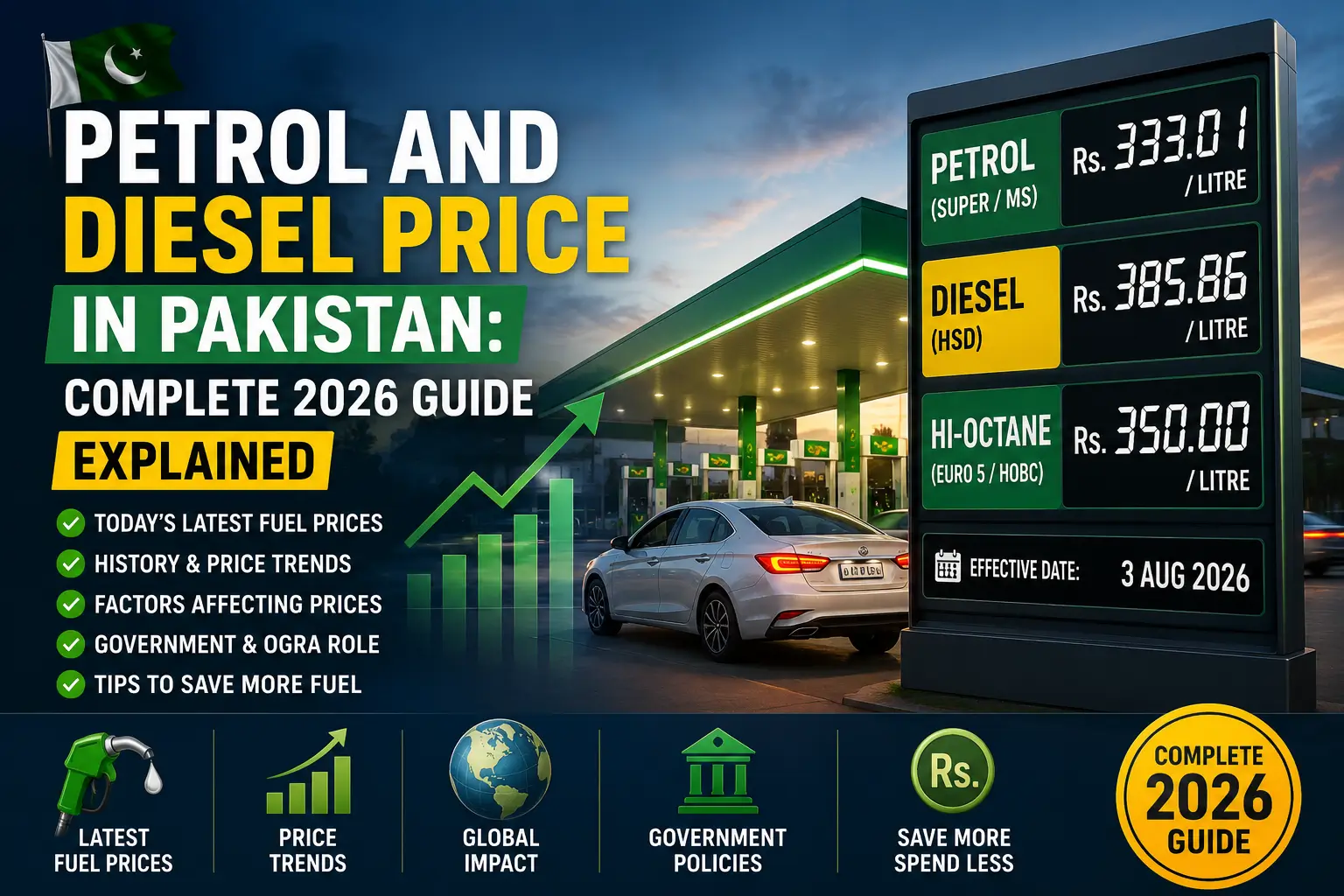
As of the most recent notification, the petrol and diesel price in Pakistan places petrol (Octane Euro 5) at roughly Rs. 355 per litre in most major cities, with High Speed Diesel priced higher at close to Rs. 386 per litre. This gap between the two fuels is a consistent pattern — diesel typically carries a higher per-litre cost than petrol in Pakistan, partly reflecting its heavier use in commercial transport and its distinct levy structure. Regional variation also exists: cities like Gilgit and Quetta, being further from major refineries and ports, see a slightly higher rate due to additional transport and freight costs.
| Product | Approx. Price | Notes |
|---|---|---|
| Petrol (Octane Euro 5) | Rs. 355/Ltr | Standard rate, most major cities |
| Petrol — Gilgit | Rs. 365/Ltr | Higher due to freight/transport cost |
| Petrol — Quetta | Rs. 357/Ltr | Slightly higher regional rate |
| High Speed Diesel | Rs. 385.86/Ltr | Used heavily in commercial transport |
| Premier Euro 5 (Petrol) | Rs. 328.56/Ltr | Lower-octane petrol variant |
| LPG | Rs. 254.32/Kg | Common household and vehicle fuel |
This snapshot of the petrol and diesel price is a moving target by design — the entire pricing mechanism exists precisely to keep domestic rates aligned with international costs and the exchange rate every two weeks. Anyone budgeting around fuel costs should treat the current figures as a baseline that can shift at the next notification, rather than a fixed number to plan around for months at a time.
Also Read: https://petrolpricepakistan.online/petrol-diesel-price-in-pakistan/
Why the Petrol and Diesel Price Matters Beyond the Pump
The petrol and diesel price does far more than determine how much it costs to fill a tank. Diesel, in particular, is the backbone of Pakistan’s freight and agricultural sectors — trucks, tractors, generators, and irrigation pumps all run on diesel, which means the diesel component of the overall petrol and diesel price feeds directly into the cost of transporting goods and running farms. When that component rises, transport companies typically pass the cost on through higher freight charges, which in turn affects the retail price of everything moved by road — from vegetables to cement to manufactured goods.
Petrol, meanwhile, has a more direct effect on household budgets, since it is the fuel used by the vast majority of private cars and motorcycles on the road. A rise in the petrol side of the equation is felt almost immediately by commuters, and because motorcycles are the dominant mode of transport for a large share of the population, changes in fuel rates have a disproportionately wide social reach compared to countries where private car ownership dominates.
In short, the petrol and diesel price functions as a kind of hidden inflation lever for the broader economy — it doesn’t just affect drivers, it ripples through freight costs, food prices, and household budgets across the country.
How the Petrol and Diesel Price Has Trended Over Recent Years
Looking at the broader pattern rather than any single notification, the petrol and diesel price in Pakistan has followed a generally upward trajectory over the past several years, punctuated by periods of relief when global oil prices eased or the rupee strengthened. Currency depreciation has been one of the most persistent upward pressures on domestic rates, often outweighing temporary dips in international crude prices. On the other hand, occasional government decisions to absorb part of a levy increase, rather than passing the full cost on to consumers, have at times slowed the pace at which fuel costs climbed.
This trend matters because it shapes expectations. Businesses that rely heavily on diesel for logistics have increasingly built fuel price volatility into their contracts and pricing models, rather than assuming the petrol and diesel price will stay flat between notifications. Households, similarly, have adjusted commuting habits, vehicle choices, and monthly budgeting around the reality that fuel costs are likely to trend upward over time, even if individual notifications occasionally bring a small decrease.
Regional Differences in the Petrol and Diesel Price
While the core petrol and diesel price is set nationally, small but consistent differences exist between cities, driven mainly by transport and distribution costs from refineries and ports to more remote regions. Areas like Gilgit-Baltistan, which sit furthest from the country’s main refining and import hubs, consistently show a somewhat higher rate than cities like Karachi or Lahore that are closer to the supply chain. Quetta similarly reflects a modest premium for the same underlying reason. For most of the country’s major urban centres — Karachi, Lahore, Islamabad, Rawalpindi, Faisalabad, Multan, and others — the retail rate is effectively uniform, since freight costs from the coast or from inland refineries to these hubs are broadly comparable.
| City | Petrol (Octane Euro 5) | Variance vs. Base Rate |
|---|---|---|
| Karachi | Rs. 355/Ltr | Base rate |
| Lahore | Rs. 355/Ltr | Base rate |
| Islamabad / Rawalpindi | Rs. 355/Ltr | Base rate |
| Faisalabad / Multan | Rs. 355/Ltr | Base rate |
| Quetta | Rs. 357/Ltr | +Rs. 2/Ltr |
| Gilgit | Rs. 365/Ltr | +Rs. 10/Ltr |
What Drives Short-Term Spikes in the Petrol and Diesel Price
Beyond the routine fortnightly adjustment, certain events can cause sharper, more sudden movement in the petrol and diesel price. Geopolitical instability in major oil-producing regions can push international crude prices higher within days, and this gets reflected quickly in the next notification. Sudden, sharp rupee depreciation against the dollar — sometimes triggered by external account pressures or shifts in investor sentiment — can likewise cause a larger-than-usual jump. Domestic policy decisions, such as a mid-cycle adjustment to the petroleum levy to meet fiscal targets, are another recurring source of sudden movement that isn’t purely market-driven.
Practical Implications for Consumers and Businesses
For the average household, the petrol and diesel price directly affects the cost of commuting, whether by private car, motorcycle, or public transport that itself runs on diesel. Budgeting around a rising rate generally means building in a buffer for fuel costs rather than assuming the previous month’s spending will hold steady. For businesses, particularly those in logistics, agriculture, and manufacturing, fuel is often one of the largest variable costs in the operating budget, and many companies now track the fortnightly notification as closely as they track exchange rates or interest rates.
Public transport fares in many cities are also indirectly tied to the petrol and diesel price, since operators frequently request fare adjustments from local authorities when the diesel component rises significantly. This means that even people who don’t own a vehicle are still affected by these rates through the cost of getting to work, school, or the market.
A Closer Look at Household Impact
For a typical urban household running one motorcycle and one small car, the petrol and diesel price effectively sets a floor on monthly transport spending that grows over time. A commuter travelling roughly 30 kilometres a day on a motorcycle, for example, will feel even a modest per-litre increase accumulate into a meaningful monthly difference once multiplied across daily use. Families that also rely on a diesel-powered generator during load-shedding hours face a second, separate exposure to the same underlying rate, since generator running costs move in step with the diesel side of the equation.
A Closer Look at Business Impact
For a mid-sized transport or logistics operator, diesel alone can represent a third or more of total operating costs, which means the diesel component of the petrol and diesel price often has a bigger effect on profitability than wage costs or vehicle maintenance combined. Many operators have responded by adding fuel surcharge clauses to client contracts, so that a documented rise in the underlying rate can be passed through transparently rather than absorbed as a shrinking margin. Some larger fleets have gone further, investing in route optimisation software or shifting a portion of deliveries to rail where feasible, specifically to reduce their exposure to fortnightly fuel notifications.
How to Stay Ahead of Fuel Rate Changes
Given that the petrol and diesel price changes on a predictable fortnightly schedule, a few practical habits can help both individuals and businesses manage the impact. Planning larger fuel purchases or refuelling just before a widely expected increase, where legally and practically possible, can offer modest savings. Businesses with high fuel dependency often build a rolling average of fuel costs into their cost models rather than reacting to each individual notification, smoothing out the impact of short-term volatility. Households can benefit from simply staying informed about the notification schedule, since knowing when the next revision is due allows for better timing of long trips or bulk fuel needs.
Comparing Fuel Options: Petrol, Diesel, and LPG
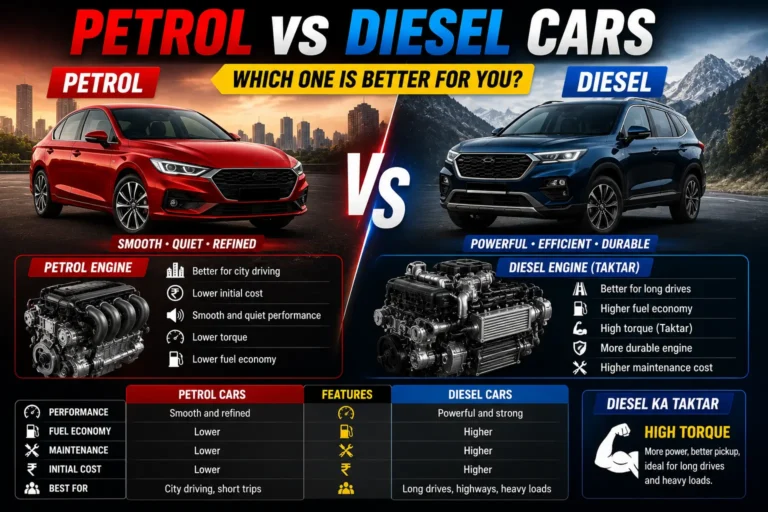
With diesel priced higher than petrol per litre and LPG sitting lower than both, some households and small businesses periodically weigh whether switching fuel types makes financial sense. For private car owners, this usually comes down to mileage: diesel engines typically deliver better fuel economy per litre than petrol engines, which can offset the higher price of diesel over enough distance, particularly for high-mileage users like ride-hailing drivers or delivery riders. LPG conversion kits remain popular among taxi and rickshaw operators specifically because the gap between LPG and petrol has, at various points, been wide enough to justify the upfront conversion cost within a year or two of regular use.
| Fuel Type | Approx. Price | Typical Use |
|---|---|---|
| Petrol (Octane Euro 5) | Rs. 355/Ltr | Private cars, motorcycles |
| Premier Euro 5 | Rs. 328.56/Ltr | Lower-octane private vehicles |
| High Speed Diesel | Rs. 385.86/Ltr | Trucks, buses, tractors, generators |
| LPG | Rs. 254.32/Kg | Converted taxis, rickshaws, households |
None of these comparisons stay fixed for long, since all three fuel categories are revised on the same fortnightly cycle and can move by different margins depending on their individual cost structure and levy treatment. A vehicle owner deciding between fuel types today should treat the current price gap as a snapshot rather than a permanent feature of the market, and revisit the comparison periodically rather than assuming today’s numbers will hold indefinitely.
Looking Ahead
The petrol and diesel price in Pakistan will continue to be shaped by the same three forces that have driven it for years: international crude oil markets, the strength or weakness of the rupee, and domestic tax and levy policy. Any meaningful and lasting reduction in fuel costs would likely require a combination of softer global oil prices and a stable or strengthening currency, since domestic levy policy has generally moved in the direction of higher, not lower, revenue collection in recent years. For now, the most realistic expectation is that the rate will continue to be revised every two weeks, with the direction of each change depending on how global and domestic conditions evolve in that window.
Staying informed about the petrol and diesel price is no longer optional for anyone managing a household budget or running a fuel-dependent business in Pakistan — it has become a routine part of financial planning, on par with tracking utility bills or rent. Whether the next notification brings a modest relief or another increase, understanding the mechanism behind it makes it far easier to plan ahead rather than simply reacting to the number posted at the pump.
Frequently Asked Questions
What is the current petrol and diesel price in Pakistan? –
As of the latest notification, petrol (Octane Euro 5) is priced at approximately Rs. 355 per litre in most major cities, while High Speed Diesel is priced at around Rs. 385.86 per litre. These figures are revised every two weeks and can shift with each new cycle. Who decides the petrol and diesel price in Pakistan? +
The Oil and Gas Regulatory Authority calculates the rate every fortnight based on international crude prices, the rupee-dollar exchange rate, freight costs, and government levies. The figure is then notified and applied uniformly by the major oil marketing companies. How often does the petrol and diesel price change? +
Rates are reviewed and revised on a fortnightly basis, roughly every two weeks. Sharp global events or sudden currency movement can occasionally trigger a mid-cycle adjustment outside this normal schedule. Why is diesel more expensive than petrol in Pakistan? +
Diesel carries a different levy structure than petrol and is more heavily used in commercial transport, agriculture, and power generation, which factors into how it is priced. This consistent gap means diesel typically costs more per litre than petrol. Why does the petrol and diesel price differ between cities? +
The base rate is set nationally, but cities farther from major refineries and ports, such as Gilgit and Quetta, carry a small additional cost to cover transport and freight, which shows up as a slightly higher local price. Does the exchange rate affect the petrol and diesel price? +
Yes, significantly. Since crude oil and refined products are purchased in US dollars, a weaker rupee raises the import cost even if international oil prices stay unchanged, which then feeds directly into the next price notification. How much of the petrol and diesel price is tax? +
A meaningful portion of the retail price comes from the petroleum development levy and, where applicable, general sales tax, rather than the base cost of the fuel itself. Levy changes alone can move the price even when global oil markets are stable. How does the petrol and diesel price affect transport fares? +
Public transport operators, many of whom run diesel vehicles, often request fare adjustments from local authorities when diesel costs rise significantly, which means commuters feel the impact even without owning a vehicle. Is LPG cheaper than petrol and diesel in Pakistan? +
LPG is generally priced lower per kilogram than both petrol and diesel per litre, which is why it remains popular among taxi and rickshaw operators using conversion kits. The exact price gap shifts with each fortnightly revision. Is the petrol and diesel price expected to fall in the near future? +
A sustained fall would generally require softer international crude prices combined with a stable or stronger rupee, since domestic levy policy has trended toward higher revenue collection in recent years. Short-term dips are possible, but a lasting reduction depends on both factors moving favourably together.Economy · Fuel · Pakistan · 2026
The petrol and diesel price in Pakistan has become one of the most closely watched economic indicators in the country, and for good reason. It touches nearly every household, every business, and every sector of the economy — from the rickshaw driver in Multan to the logistics company moving goods between Karachi and Peshawar. Understanding how this rate is determined, why it moves the way it does, and what factors are likely to shape it going forward is essential for anyone trying to plan a monthly budget, run a transport business, or simply make sense of the news.
This guide takes a professional, structured look at the current petrol and diesel price in Pakistan, the mechanism behind it, the historical pattern of change, and the practical implications for ordinary consumers. Rather than treating it as a single abstract number, it’s worth breaking the topic down into its real components — global crude oil trends, currency movement, taxation, and domestic policy — because each of these plays a distinct role in shaping what you see posted at your local pump.
How the Petrol and Diesel Price Is Determined in Pakistan
Unlike some countries where fuel is sold at a fully deregulated market rate, the petrol and diesel price in Pakistan follows a regulated pricing formula overseen by the Oil and Gas Regulatory Authority. Every two weeks, the regulator calculates an updated rate based on the international price of crude oil and refined products, the prevailing exchange rate between the Pakistani rupee and the US dollar, freight and inland distribution costs, and applicable government levies such as the petroleum development levy and general sales tax. Once calculated, the new figure is notified and then implemented uniformly by the major oil marketing companies across the country.
This fortnightly cycle means the petrol and diesel price is never static for long. A sharp move in global oil markets, a weakening rupee, or a change in the government’s levy policy can all shift the rate within a single notification cycle. For businesses that depend heavily on fuel — public transport operators, freight companies, agricultural machinery operators — this fortnightly revision is one of the most important dates on their operational calendar.
The Role of International Crude Oil Prices
Since Pakistan imports the vast majority of its crude oil and refined petroleum products, the domestic petrol and diesel price is directly linked to international benchmark prices. When global crude oil prices rise, the import cost of refined fuel rises with it, and this is reflected in the next notification. Because Pakistan does not produce enough crude domestically to insulate its market from global swings, local rates effectively import global volatility along with the fuel itself.
The Impact of the Exchange Rate
Even when international oil prices stay flat, a weaker rupee against the US dollar can still push the petrol and diesel price higher, because all crude and refined product purchases are settled in dollars. This is one of the least visible but most consistent drivers of fuel costs in Pakistan — a currency depreciation of even a few rupees against the dollar can add a noticeable amount to the next cycle, independent of anything happening in oil markets themselves.
Taxes and Levies
A significant portion of the petrol and diesel price consumers pay at the pump is made up of government levies rather than the underlying cost of the fuel itself. The petroleum development levy, in particular, is a fixed per-litre charge that the government can adjust to meet revenue targets, and changes to this levy show up directly in what drivers pay. General sales tax, where applicable to specific products, adds a further layer on top. Understanding this breakdown helps explain why rates sometimes rise even when global oil markets are relatively calm — a policy-driven levy adjustment can move the numbers on its own.
Current Petrol and Diesel Price Snapshot
As of the most recent notification, the petrol and diesel price in Pakistan places petrol (Octane Euro 5) at roughly Rs. 355 per litre in most major cities, with High Speed Diesel priced higher at close to Rs. 386 per litre. This gap between the two fuels is a consistent pattern — diesel typically carries a higher per-litre cost than petrol in Pakistan, partly reflecting its heavier use in commercial transport and its distinct levy structure. Regional variation also exists: cities like Gilgit and Quetta, being further from major refineries and ports, see a slightly higher rate due to additional transport and freight costs.
| Product | Approx. Price | Notes |
|---|---|---|
| Petrol (Octane Euro 5) | Rs. 355/Ltr | Standard rate, most major cities |
| Petrol — Gilgit | Rs. 365/Ltr | Higher due to freight/transport cost |
| Petrol — Quetta | Rs. 357/Ltr | Slightly higher regional rate |
| High Speed Diesel | Rs. 385.86/Ltr | Used heavily in commercial transport |
| Premier Euro 5 (Petrol) | Rs. 328.56/Ltr | Lower-octane petrol variant |
| LPG | Rs. 254.32/Kg | Common household and vehicle fuel |
This snapshot of the petrol and diesel price is a moving target by design — the entire pricing mechanism exists precisely to keep domestic rates aligned with international costs and the exchange rate every two weeks. Anyone budgeting around fuel costs should treat the current figures as a baseline that can shift at the next notification, rather than a fixed number to plan around for months at a time.
Why the Petrol and Diesel Price Matters Beyond the Pump
The petrol and diesel price does far more than determine how much it costs to fill a tank. Diesel, in particular, is the backbone of Pakistan’s freight and agricultural sectors — trucks, tractors, generators, and irrigation pumps all run on diesel, which means the diesel component of the overall petrol and diesel price feeds directly into the cost of transporting goods and running farms. When that component rises, transport companies typically pass the cost on through higher freight charges, which in turn affects the retail price of everything moved by road — from vegetables to cement to manufactured goods.
Petrol, meanwhile, has a more direct effect on household budgets, since it is the fuel used by the vast majority of private cars and motorcycles on the road. A rise in the petrol side of the equation is felt almost immediately by commuters, and because motorcycles are the dominant mode of transport for a large share of the population, changes in fuel rates have a disproportionately wide social reach compared to countries where private car ownership dominates.
In short, the petrol and diesel price functions as a kind of hidden inflation lever for the broader economy — it doesn’t just affect drivers, it ripples through freight costs, food prices, and household budgets across the country.
How the Petrol and Diesel Price Has Trended Over Recent Years
Looking at the broader pattern rather than any single notification, the petrol and diesel price in Pakistan has followed a generally upward trajectory over the past several years, punctuated by periods of relief when global oil prices eased or the rupee strengthened. Currency depreciation has been one of the most persistent upward pressures on domestic rates, often outweighing temporary dips in international crude prices. On the other hand, occasional government decisions to absorb part of a levy increase, rather than passing the full cost on to consumers, have at times slowed the pace at which fuel costs climbed.
This trend matters because it shapes expectations. Businesses that rely heavily on diesel for logistics have increasingly built fuel price volatility into their contracts and pricing models, rather than assuming the petrol and diesel price will stay flat between notifications. Households, similarly, have adjusted commuting habits, vehicle choices, and monthly budgeting around the reality that fuel costs are likely to trend upward over time, even if individual notifications occasionally bring a small decrease.
Regional Differences in the Petrol and Diesel Price
While the core petrol and diesel price is set nationally, small but consistent differences exist between cities, driven mainly by transport and distribution costs from refineries and ports to more remote regions. Areas like Gilgit-Baltistan, which sit furthest from the country’s main refining and import hubs, consistently show a somewhat higher rate than cities like Karachi or Lahore that are closer to the supply chain. Quetta similarly reflects a modest premium for the same underlying reason. For most of the country’s major urban centres — Karachi, Lahore, Islamabad, Rawalpindi, Faisalabad, Multan, and others — the retail rate is effectively uniform, since freight costs from the coast or from inland refineries to these hubs are broadly comparable.
| City | Petrol (Octane Euro 5) | Variance vs. Base Rate |
|---|---|---|
| Karachi | Rs. 355/Ltr | Base rate |
| Lahore | Rs. 355/Ltr | Base rate |
| Islamabad / Rawalpindi | Rs. 355/Ltr | Base rate |
| Faisalabad / Multan | Rs. 355/Ltr | Base rate |
| Quetta | Rs. 357/Ltr | +Rs. 2/Ltr |
| Gilgit | Rs. 365/Ltr | +Rs. 10/Ltr |
What Drives Short-Term Spikes in the Petrol and Diesel Price
Beyond the routine fortnightly adjustment, certain events can cause sharper, more sudden movement in the petrol and diesel price. Geopolitical instability in major oil-producing regions can push international crude prices higher within days, and this gets reflected quickly in the next notification. Sudden, sharp rupee depreciation against the dollar — sometimes triggered by external account pressures or shifts in investor sentiment — can likewise cause a larger-than-usual jump. Domestic policy decisions, such as a mid-cycle adjustment to the petroleum levy to meet fiscal targets, are another recurring source of sudden movement that isn’t purely market-driven.
Practical Implications for Consumers and Businesses
For the average household, the petrol and diesel price directly affects the cost of commuting, whether by private car, motorcycle, or public transport that itself runs on diesel. Budgeting around a rising rate generally means building in a buffer for fuel costs rather than assuming the previous month’s spending will hold steady. For businesses, particularly those in logistics, agriculture, and manufacturing, fuel is often one of the largest variable costs in the operating budget, and many companies now track the fortnightly notification as closely as they track exchange rates or interest rates.
Public transport fares in many cities are also indirectly tied to the petrol and diesel price, since operators frequently request fare adjustments from local authorities when the diesel component rises significantly. This means that even people who don’t own a vehicle are still affected by these rates through the cost of getting to work, school, or the market.
A Closer Look at Household Impact
For a typical urban household running one motorcycle and one small car, the petrol and diesel price effectively sets a floor on monthly transport spending that grows over time. A commuter travelling roughly 30 kilometres a day on a motorcycle, for example, will feel even a modest per-litre increase accumulate into a meaningful monthly difference once multiplied across daily use. Families that also rely on a diesel-powered generator during load-shedding hours face a second, separate exposure to the same underlying rate, since generator running costs move in step with the diesel side of the equation
A Closer Look at Business Impact
For a mid-sized transport or logistics operator, diesel alone can represent a third or more of total operating costs, which means the diesel component of the petrol and diesel price often has a bigger effect on profitability than wage costs or vehicle maintenance combined. Many operators have responded by adding fuel surcharge clauses to client contracts, so that a documented rise in the underlying rate can be passed through transparently rather than absorbed as a shrinking margin. Some larger fleets have gone further, investing in route optimisation software or shifting a portion of deliveries to rail where feasible, specifically to reduce their exposure to fortnightly fuel notifications.
How to Stay Ahead of Fuel Rate Changes
Given that the petrol and diesel price changes on a predictable fortnightly schedule, a few practical habits can help both individuals and businesses manage the impact. Planning larger fuel purchases or refuelling just before a widely expected increase, where legally and practically possible, can offer modest savings. Businesses with high fuel dependency often build a rolling average of fuel costs into their cost models rather than reacting to each individual notification, smoothing out the impact of short-term volatility. Households can benefit from simply staying informed about the notification schedule, since knowing when the next revision is due allows for better timing of long trips or bulk fuel needs.
Comparing Fuel Options: Petrol, Diesel, and LPG
With diesel priced higher than petrol per litre and LPG sitting lower than both, some households and small businesses periodically weigh whether switching fuel types makes financial sense. For private car owners, this usually comes down to mileage: diesel engines typically deliver better fuel economy per litre than petrol engines, which can offset the higher price of diesel over enough distance, particularly for high-mileage users like ride-hailing drivers or delivery riders. LPG conversion kits remain popular among taxi and rickshaw operators specifically because the gap between LPG and petrol has, at various points, been wide enough to justify the upfront conversion cost within a year or two of regular use.
| Fuel Type | Approx. Price | Typical Use |
|---|---|---|
| Petrol (Octane Euro 5) | Rs. 355/Ltr | Private cars, motorcycles |
| Premier Euro 5 | Rs. 328.56/Ltr | Lower-octane private vehicles |
| High Speed Diesel | Rs. 385.86/Ltr | Trucks, buses, tractors, generators |
| LPG | Rs. 254.32/Kg | Converted taxis, rickshaws, households |
None of these comparisons stay fixed for long, since all three fuel categories are revised on the same fortnightly cycle and can move by different margins depending on their individual cost structure and levy treatment. A vehicle owner deciding between fuel types today should treat the current price gap as a snapshot rather than a permanent feature of the market, and revisit the comparison periodically rather than assuming today’s numbers will hold indefinitely.
Looking Ahead
The petrol and diesel price in Pakistan will continue to be shaped by the same three forces that have driven it for years: international crude oil markets, the strength or weakness of the rupee, and domestic tax and levy policy. Any meaningful and lasting reduction in fuel costs would likely require a combination of softer global oil prices and a stable or strengthening currency, since domestic levy policy has generally moved in the direction of higher, not lower, revenue collection in recent years. For now, the most realistic expectation is that the rate will continue to be revised every two weeks, with the direction of each change depending on how global and domestic conditions evolve in that window.
Staying informed about the petrol and diesel price is no longer optional for anyone managing a household budget or running a fuel-dependent business in Pakistan — it has become a routine part of financial planning, on par with tracking utility bills or rent. Whether the next notification brings a modest relief or another increase, understanding the mechanism behind it makes it far easier to plan ahead rather than simply reacting to the number posted at the pump.