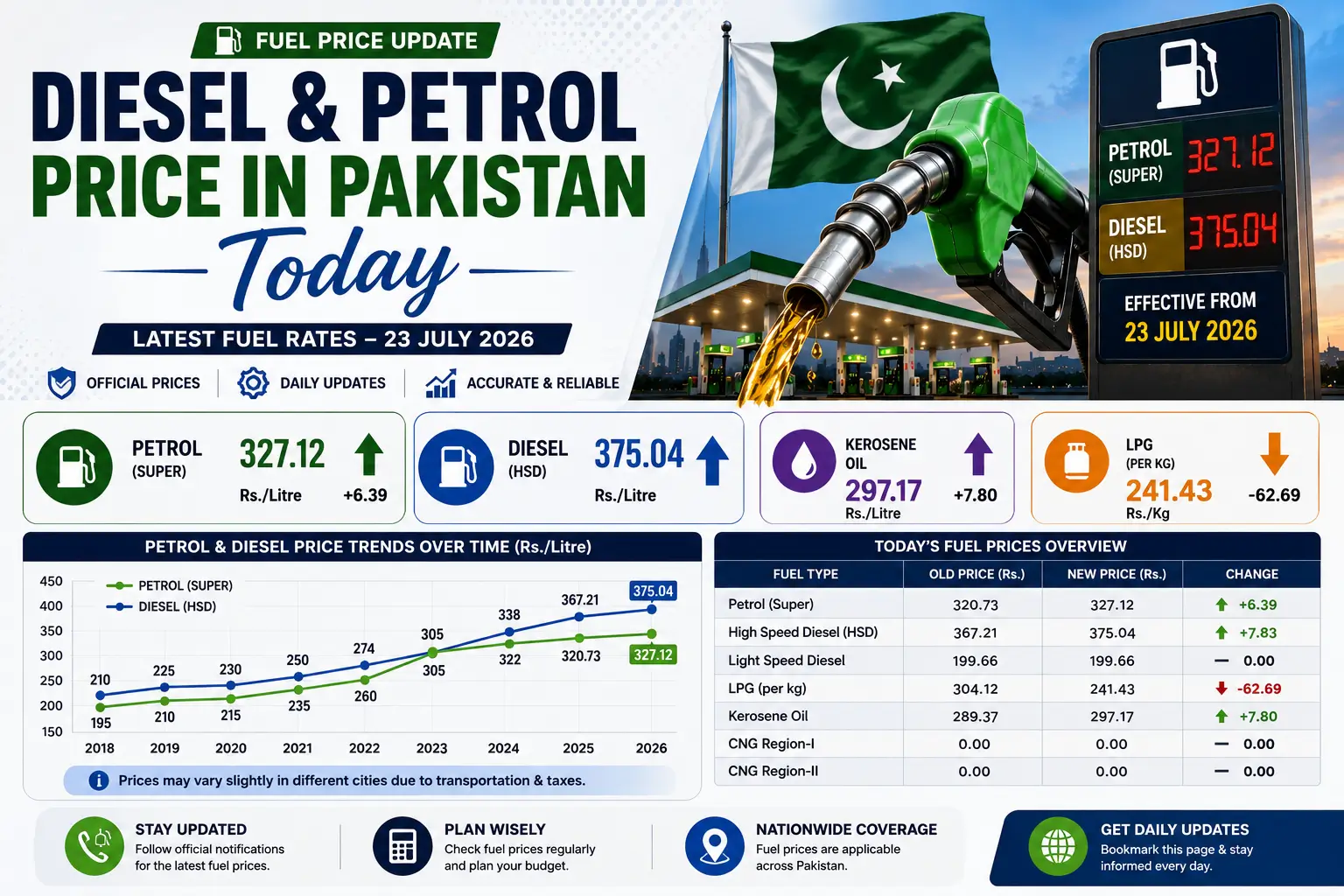
fwPrice Trends Over Time 2026 – Important Updates
Petrol & Diesel Price Trends Over Time provides a detailed overview of how fuel prices in Pakistan have changed over the years. Track historical Petrol & Diesel rates, compare price increases and decreases, analyze market trends, and stay informed with the latest fuel price updates to understand the impact of global oil prices and government policies.
Pakistan’s fuel market over the last two years is a textbook case of just how volatile pump prices can get, moving from a relatively calm plateau in 2025 to one of the sharpest price shocks in the country’s history in 2026, followed by a partial correction. This article walks through that journey, the numbers behind it, and what the trend suggests for the months ahead.
Long-Term Petrol Price Milestones (2000–2026)
Pakistan’s fuel prices have risen dramatically over the past two and a half decades. The table below highlights some of the key milestones that mark the country’s long-term petrol price trend.
| Period | Approx. Petrol Price (PKR/Litre) | Notable Development |
|---|---|---|
| 2000 | 28 – 30 | Fuel remained affordable relative to incomes |
| 2008 | ~66 | Global oil prices begin climbing sharply |
| 2013 | ~104 | Petrol crosses the Rs. 100 mark |
| 2019 | 91 – 114 | Steady annual increases resume |
| Sept 2023 | ~331 | Record high driven by a steep petroleum levy hike |
| Oct 2024 | ~247 | Correction phase as crude and the rupee stabilise |
| 2025 (avg.) | 252 – 270 | A year-long plateau after the 2023 shock |
| Apr 2026 | ~458 | All-time high following the Strait of Hormuz crisis |
| Jun 2026 | ~378 | Partial relief as crude prices ease |
| 23 Jul 2026 | 327.12 | Current price, still trending upward |
2025: A Year of Relative Stability
After the record-breaking increases of 2023, when the petroleum levy was pushed close to its legal ceiling to meet fiscal targets set under Pakistan’s Petrol & Diesel IMF programme, 2025 turned out to be comparatively calm. Petrol spent most of the year in a fairly narrow band, generally moving between roughly Rs. 252 and Rs. 270 per litre, before edging higher toward the Rs. 400 mark by December as the rupee came under renewed pressure. Businesses and households had just begun adjusting their budgets to this new “normal” baseline when conditions shifted dramatically in early 2026.
2026: The Strait of Hormuz Shock
The defining event of the 2026 fuel price trend was a geopolitical shock rather than a purely economic one. Late in February 2026, a joint military escalation involving the United States and Israel against Iran led Tehran to respond by restricting traffic through the Strait of Hormuz — the narrow shipping lane that carries roughly a fifth of the world’s daily oil supply. Because a large share of Pakistan’s crude oil imports pass through this corridor, the disruption fed almost immediately into domestic pricing.
Within days, Petrol & Diesel prices began climbing sharply. By early March, the rate had already crossed Rs. 320 per litre, and the increases continued through the following weeks as Gulf shipping routes remained constrained. Petrol & Diesel was hit even harder, briefly moving above Rs. 520 per litre at the height of the crisis — a level without real precedent in Pakistan’s fuel pricing history. By early April 2026, petrol touched an all-time high of roughly Rs. 458 per litre, meaning the price had risen by well over 40 percent in a matter of weeks.
Petrol & Diesel Correction (April–July 2026)
As Gulf shipping conditions gradually normalised under international mediation and global crude benchmarks eased back from their crisis peak of over $130 a barrel toward the $72–78 range, Pakistan’s fuel prices began correcting. A series of fortnightly and,
later, more frequent revisions brought petrol down step by step: from the April peak near Rs. 458, to roughly Rs. 414 in early May, briefly rising again to around Rs. 414.78 before a mid-month cut brought it back to about Rs. 409.78, and then a further reduction of roughly Rs. 22 per litre on 30 May offered households some real relief. By early June, petrol had eased to around Rs. 378 per litre, with Petrol & Diesel holding near Rs. 380.
Since then, the trend has been a gradual, uneven climb rather than a sharp jump, with prices moving from the low Rs. 300s back up toward today’s rate of Rs. 327.12. This pattern — a violent spike followed by a slow, partial recovery that still leaves prices meaningfully above the pre-crisis baseline — is a common signature of geopolitically driven oil shocks.
Monthly Snapshot: Petrol Price Movement in 2026
| Month (2026) | Approx. Petrol Price (PKR/Litre) | Trend |
|---|---|---|
| January | ~253 | Stable, carried over from 2025 |
| February | ~258 | Minor upward adjustments begin |
| March | ~321 | Sharp rise after Strait of Hormuz escalation |
| April | ~458 (peak) | All-time high recorded |
| May | 393 – 415 | Volatile, partial relief mid-month |
| June | ~378 | Continued easing as crude stabilises |
| July | 310 – 327 | Gradual upward drift resumes |
Even after the June relief, today’s price of Rs. 327.12 remains well above the Rs. 250–270 range that had become the norm through most of 2025 — a reminder that while the sharpest part of the 2026 shock has passed, fuel costs have not returned to their pre-crisis baseline.
What Drives Petrol & Diesel Trends?
Several overlapping forces shape the direction of Petrol & Diesel prices in Pakistan over time:
Diesel: A Steeper, More Volatile Trend
High Speed Diesel has generally tracked petrol’s direction but with sharper swings. During the 2026 crisis, diesel briefly traded above Rs. 520 per litre — a bigger percentage jump than petrol saw over the same period — largely because diesel demand from shipping, power generation, and heavy transport makes it especially sensitive to supply disruptions at global chokepoints. Today’s diesel price of Rs. 375.04 sits well below that crisis peak but still noticeably above the levels seen for most of 2025, underlining how much of the 2026 shock has yet to fully unwind.
Comparing the 2023 and 2026 Petrol & Diesel Price Shocks
Pakistan has now experienced two very different types of fuel price shocks within a few years. The September 2023 spike to around Rs. 331 per litre was largely a policy-driven event, caused by a steep increase in the petroleum levy to meet fiscal commitments rather than a sudden change in global oil supply. The 2026 shock, by contrast, was triggered by an external geopolitical crisis that disrupted physical oil shipments through one of the world’s most important maritime corridors. rally higher than before either shock, reflecting a broader long-term upward trend in the cost of fuel in Pakistan.
What the Trend Suggests Going Forward
Taken together, the data points to a few broad conclusions. First, Pakistan’s heavy reliance on imported crude and refined fuel means domestic prices will keep moving in step with international markets and, in particular, with conditions around key shipping routes such as the Strait of Hormuz. Second, even after sharp corrections, prices have tended to settle at a higher baseline than before each shock, suggesting a long-term upward trend beneath the short-term ups and downs. Third, currency stability and petroleum levy decisions will remain just as important as global crude prices in determining where Petrol & Diesel head next.
Petrol & Diesel Regional and Global Context
Pakistan’s price swings in 2026 were not happening in isolation. Trading Economics data shows that gasoline prices in Pakistan, measured in US dollar terms, rose from about $0.93 per litre in February 2026 to roughly $1.15 per litre by March, tracking the same crisis that pushed localv Petrol & Diesel rupee prices to record highs. That dollar-denominated figure matched the all-time high last seen back in September 2023, underscoring how closely Pakistan’s domestic fuel market is tied to global benchmarks rather than moving independently.
Also Read: https://petrolpricepakistan.online/
Reading the Trend Line: Key Takeaways
After hitting an all-time high of around Rs. 458 per litre in April 2026 following the Strait of Hormuz crisis, petrol has partially corrected and is now trending gradually upward again from a June low, standing Petrol & Diesel at Rs. 327.12 per litre as of 23 July 2026.
Petrol & Diesel FAQs
Note: Figures in this article are compiled from OGRA notifications and public fuel-price tracking sources and reflect data available as of 23 July 2026. Historical figures for earlier years are approximate and intended to illustrate long-term trends; please confirm exact historical rates with official OGRA records where precision is required.