Diesel and Petrol Price in Pakistan Today
Stay updated with the latest Diesel and Petrol Price in Pakistan Today. Check today’s fuel rates, including petrol, high-speed diesel (HSD), LPG, kerosene oil, and other petroleum prices with daily updates and official notifications.
Stay updated with the latest Diesel and Petrol Price in Pakistan Today. Check today’s fuel rates, including petrol, high-speed diesel (HSD), LPG, kerosene oil, and other petroleum prices with daily updates and official notifications.
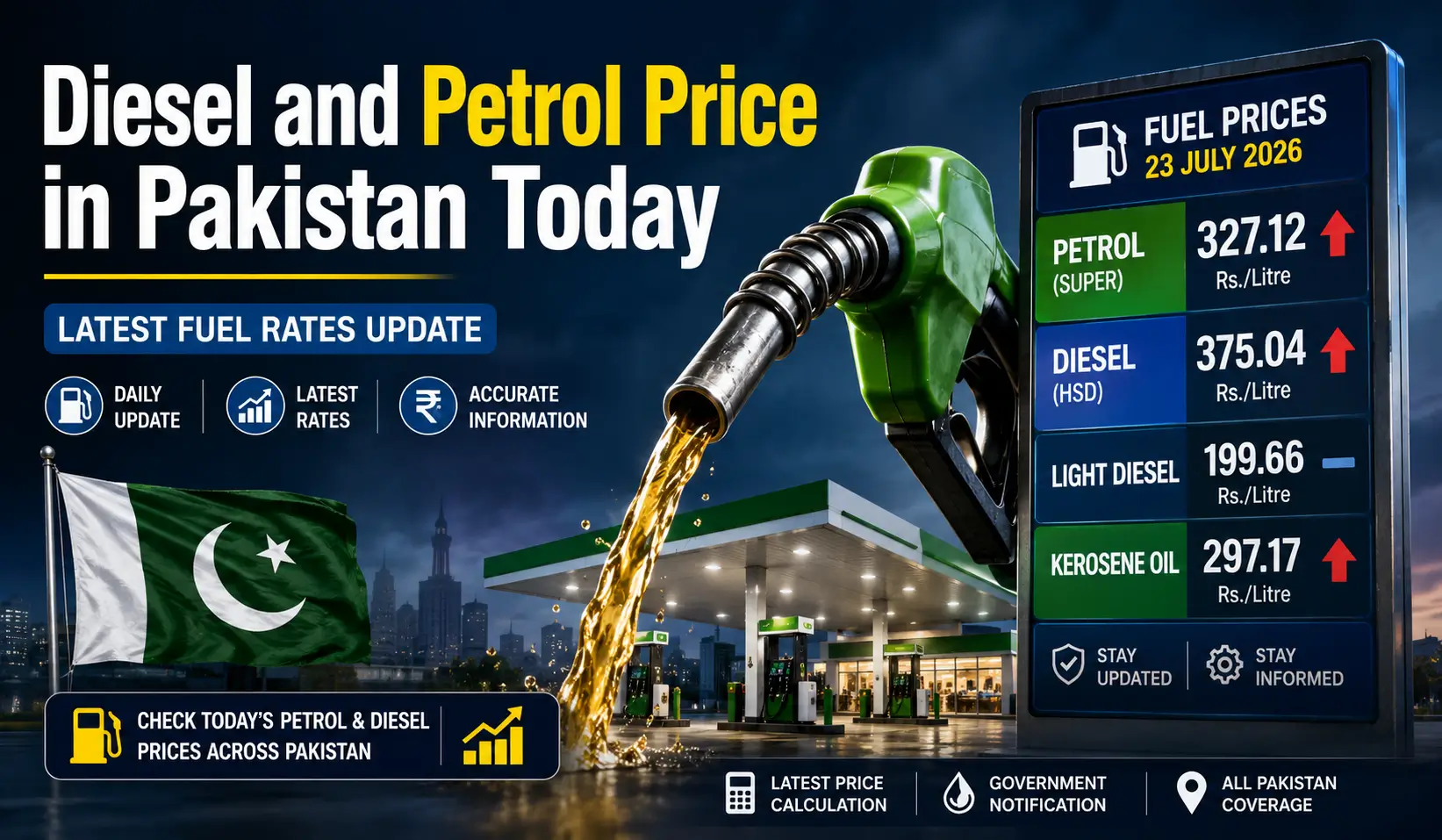
Current and Latest Petrol Price in Pakistan is Rs. 327.12/Litre, High Speed Diesel is Rs. 375.04/Litre
Fuel prices are one of the most closely watched numbers in Pakistan, and for good reason. Every time the government revises the rate of petrol or Diesel and Petrol, the ripple effect reaches almost every household within days — from the fare a commuter pays for a rickshaw ride to the price of vegetables at the local market. As of today, 23 July 2026, the price of petrol in Pakistan stands at Rs. 327.12 per litre, while High Speed Diesel and Petrol (HSD) is priced at Rs. 375.04 per litre, following a fresh increase of Rs. 6.39 and Rs. 7.83 per litre respectively.
Petroleum Prices in Pakistan Today
This latest revision was made on the recommendation of the Oil and Gas Regulatory Authority (OGRA) and was notified by the Ministry of Petroleum. Under Pakistan’s daily petroleum pricing mechanism, fuel rates are reviewed regularly and can change from one day to the next depending on international crude oil prices, the exchange rate of the rupee against the US dollar, and domestic tax adjustments. The table below summarises today’s rates across all major categories of petroleum products sold in the country.
Prices with effect from 23 July 2026
As the table shows, petrol and high-speed Diesel and Petrol both moved higher in this revision, while LPG has come down compared to its earlier rate in March 2026. Kerosene oil, used mainly for heating and lighting in areas without access to piped gas, also went up marginally. CNG prices in Region-I and Region-II are no longer centrally regulated in most parts of the country, which is why they are frequently listed as unavailable or zero in official price sheets — actual CNG rates now vary by province and by individual filling station.
| Fuel Type | Old Price (PKR) | New Price (PKR) | Difference |
|---|---|---|---|
| Petrol (Super) | 320.73 | 327.12 | ▲ 6.39 |
| High Speed Diesel | 367.21 | 375.04 | ▲ 7.83 |
| Light Speed Diesel | 199.66 | 199.66 | — 0.00 |
| LPG (per kg) | 304.12 | 241.43 | ▼ 62.69 |
| Kerosene Oil | 289.37 | 297.17 | ▲ 7.80 |
| CNG Region-I | 0.00 | 0.00 | — 0.00 |
| CNG Region-II | 0.00 | 0.00 | — 0.00 |
Types of Petroleum in Pakistan
Petroleum, commonly referred to as crude oil, is a naturally occurring liquid found beneath the earth’s surface. It is formed over millions of years through the gradual decomposition of organic matter under intense heat and pressure. Because it is a fossil fuel, petroleum must pass through specialised refining processes before it can be used as a source of energy for vehicles, industry, or households. Pakistan imports the bulk of its crude oil and refined products, which is one of the main reasons domestic fuel prices are so sensitive to global oil markets and to the value of the rupee. The most common categories of petroleum products sold in Pakistan include:
- Petrol (Super) — the most widely used fuel for cars, motorcycles, and rickshaws, valued for its higher octane rating and smoother engine performance.
- High Speed Diesel and Petrol (HSD) — the backbone of the transport and agriculture sectors, used to run trucks, buses, tractors, and heavy machinery.
- Light Speed Diesel and Petrol (LSD) — a lighter grade of diesel used in select industrial and marine applications.
- Kerosene Oil — commonly used for heating, lighting, and cooking in remote and off-grid areas.
- Liquefied Petroleum Gas (LPG) — used both as a vehicle fuel and as a substitute for natural gas in households that lack a piped gas connection.
- Compressed Natural Gas (CNG) — a cleaner-burning alternative fuel compressed to high pressure for use in vehicles.
Petrol, also called Motor Spirit or Super Petrol, remains the fuel of choice for the millions of motorcycles, cars, and auto-rickshaws that dominate Pakistan’s roads. High Speed Diesel and Petrol, on the other hand, plays an outsized role in the economy because it powers freight transport and farm machinery — meaning a rise in diesel prices tends to push up the cost of everything from bus fares to the price of wheat and vegetables.
Also Read: https://petrolpricepakistan.online/
How Petrol and Diesel Prices Are Determined
Pakistan currently follows a daily petroleum pricing mechanism, which means the government reviews and can adjust petrol and diesel rates every 24 hours instead of the fortnightly cycle used in earlier years. Several factors go into every revision:
- International crude oil prices — since Pakistan imports most of its petroleum products, any movement in global oil markets feeds directly into the local price.
- Exchange rate — because oil is purchased in US dollars, a weaker rupee makes imported fuel more expensive even if global oil prices stay flat.
- Petroleum levy and taxes — the government adjusts the petroleum levy from time to time, which directly affects the retail price paid at the pump.
- Freight and distribution margins — costs of moving fuel from ports and refineries to filling stations across the country are built into the final price
- OGRA’s recommendations — the Oil and Gas Regulatory Authority calculates the ex-depot price and recommends it to the Ministry of Petroleum, which then issues a formal notification.
Once the Ministry of Petroleum notifies the new rates, they typically take effect from midnight and remain in force until the next revision. This system is designed to keep domestic prices closely aligned with international markets, but it also means Pakistani consumers can see fairly frequent — and sometimes sharp — swings in what they pay at the pump.
History of Petrol Prices in Pakistan
Tracking how petrol prices have moved over recent weeks helps put today’s rate in context. The table below lists the petrol price on each of the most recent revision dates.
| Date | Petrol Price (PKR/Litre) |
|---|---|
| 23 July 2026 | 327.12 |
| 22 July 2026 | 320.73 |
| 21 July 2026 | 315.80 |
| 18 July 2026 | 316.15 |
| 11 July 2026 | 310.71 |
| 04 July 2026 | 297.53 |
Looking at this short history, petrol has climbed by roughly Rs. 30 per litre over the span of about three weeks, moving from Rs. 297.53 on 4 July to Rs. 327.12 on 23 July. This kind of steady upward movement is typical during periods of rising international crude prices or a weakening rupee, and it illustrates why households and businesses in Pakistan often plan their budgets with fuel price volatility in mind.
Also Read:https://petrolpricepakistan.online/petrol-diesel-price-trends/
Why Petrol Prices Matter to Everyday Life
A fuel price hike in Pakistan rarely stops at the petrol pump. Because Diesel and Petrol powers the trucks and tractors that move goods across the country, higher HSD prices tend to filter into freight charges, which in turn push up the price of groceries, construction materials, and manufactured goods. Public transport fares, rickshaw and taxi rates, and even the cost of home deliveries typically rise in tandem with fuel prices. For households already managing tight budgets, a fresh increase in petrol or diesel rates can mean higher spending across nearly every category, from commuting to cooking.
At the same time, a decline in fuel prices — as seen periodically in LPG rates — can offer some relief, particularly to households that rely on LPG cylinders for cooking or heating in areas without piped gas. Because of this direct link between fuel costs and the broader cost of living, petrol and Diesel price announcements are closely tracked by commuters, transporters, farmers, and businesses alike.
Impact on Key Sectors
Transport Sector: Public and private transport operators are among the first to feel the effect of a fuel price hike. Intercity bus and coach services often revise their fares within days of a Diesel and Petrol price increase, while local rickshaw and taxi drivers frequently push for higher meter rates or negotiate informal surcharges with passengers.
Agriculture Sector: Diesel and Petrol is the lifeblood of Pakistani agriculture, powering tractors, tube wells, and threshers across the country’s farmland. When HSD prices rise, the cost of ploughing, irrigation, and harvesting rises with it, and farmers often pass some of that cost on through higher prices for wheat, rice, sugarcane, and vegetables.
Industry and Logistics: Manufacturers and logistics companies factor Diesel and Petrol costs into the price of moving raw materials and finished goods between cities and ports. A sustained increase in fuel prices tends to raise transportation and production costs across industries such as textiles, cement, and consumer goods.
Household Budgets: For an average family, the effect of a fuel price hike is felt indirectly through higher transport fares, delivery charges, and the price of everyday essentials, rather than through a fuel bill alone.
Diesel and Petrol Prices in Pakistan vs the Region
Pakistan’s fuel prices are frequently compared with those of neighbouring countries such as India, Bangladesh, and Sri Lanka, as well as with other South Asian economies. While direct comparisons can be misleading because of differences in currency value, Diesel and Petrol taxation, and subsidy structures, Pakistan’s petrol has at times ranked among the more expensive fuels in the region relative to average incomes. This is partly because Pakistan imports almost all of its crude oil and refined products, leaving domestic prices highly exposed to global market swings and to fluctuations in the rupee-dollar exchange rate.
Diesel and Petrol -Efficient Vehicles Popular in Pakistan
With fuel costs forming a significant part of vehicle ownership expenses, many buyers in Pakistan now prioritise fuel economy alongside price and reliability when choosing a car. Compact hatchbacks and small sedans with 1000cc to 1300cc engines remain popular precisely because they offer a favourable balance between running costs and everyday practicality. Models frequently cited for strong fuel efficiency in the local market include small hatchbacks such as the Suzuki Alto,Diesel and Petrol compact sedans such as the Toyota Yaris and Honda City, and select crossover and SUV options that combine reasonable mileage with extra space for families.
Diesel and Petrol [FAQs]
The latest Diesel and Petrol Price in Pakistan Today reflects another increase in fuel rates, adding to transportation and household expenses across the country. Petrol now costs Rs. 327.12 per litre, while High-Speed Diesel and Petrol has reached Rs. 375.04 per litre. These revised prices became effective on 23 July 2026 following the government’s latest fuel price notification. Consumers are advised to stay updated with official announcements, as future changes in global oil prices and exchange rates may lead to further adjustments in petroleum prices.