Good News: Petrol and Diesel Prices Cut Again in Pakistan
Petrol drops by Rs. 4.80 and diesel by Rs. 2.45 per litre in the newest official notification — here’s the full breakdown, the numbers, and what’s behind the relief.
Confirmed by official notification
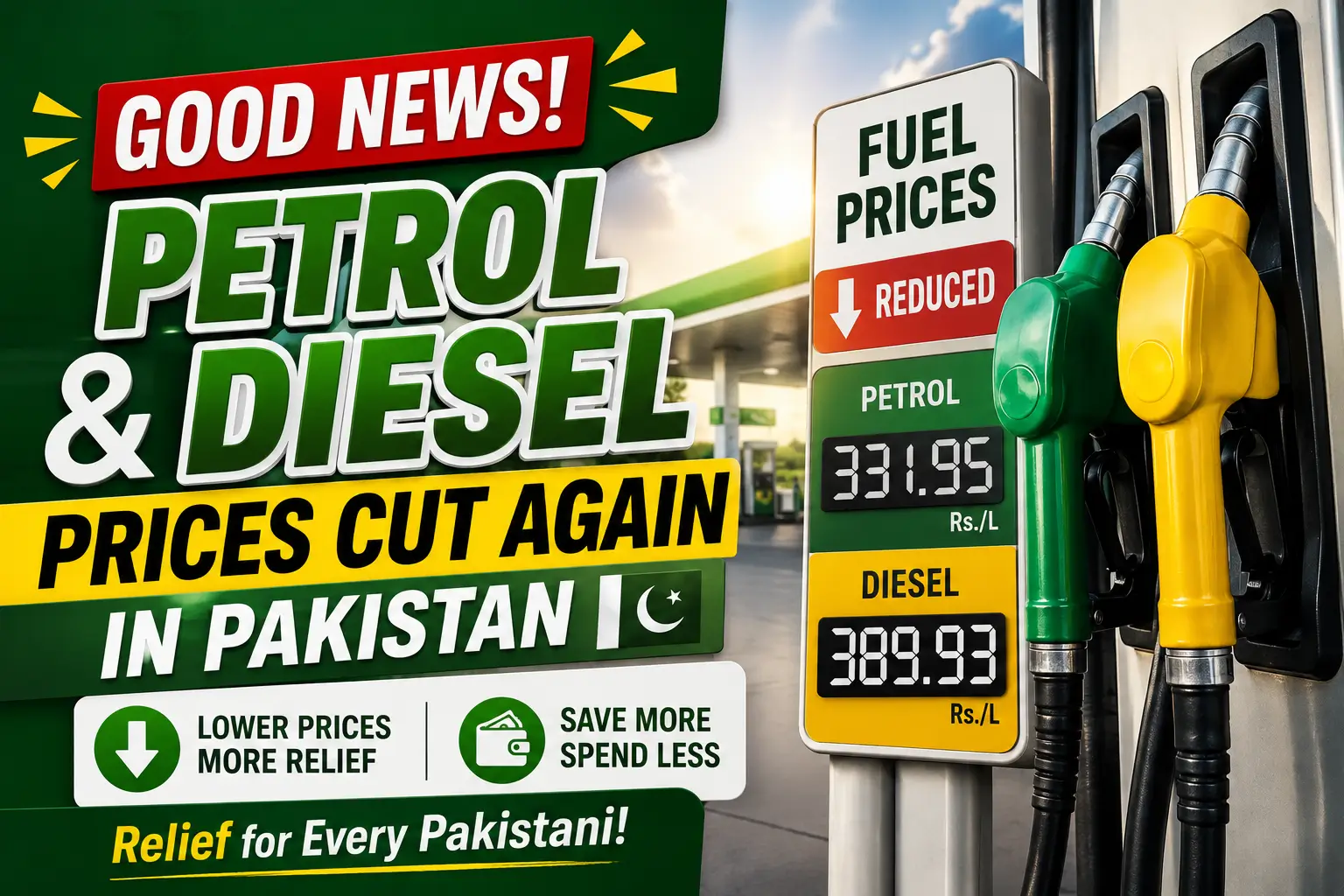
Petrol (Motor Spirit)
Rs. 331.95 / litre
▼ Down Rs. 4.80 per litre
High-Speed Diesel (HSD)
Rs. 389.93 / litre
▼ Down Rs. 2.45 per litre
These figures reflect the reduction announced in the latest official notification. Because Pakistan now reviewsGood News: Petrol and Diesel Prices every few days, always cross-check the very latest rate with OGRA or a major retailer before relying on this number for a future date.
There’s finally some breathing room for Pakistani households and businesses. According to the latest official notification, Petrol and Diesel Prices have been reduced by Rs. 4.80 per litre, bringing the new price down to Rs. 331.95 per litre, while High-Speed Diesel has dropped by Rs. 2.45 per litre to Rs. 389.93 per litre. After a stretch of steady increases driven by global oil market volatility, this cut offers welcome relief to commuters, transporters, and anyone who has felt the pinch of rising fuel costs in recent weeks.
What Exactly Changed
The notification confirms two separate reductions. Petrol, used by the vast majority of motorcycles and private cars on Pakistani roads, is now cheaper by Rs. 4.80 per litre. Diesel, the fuel that keeps freight trucks, buses, tractors, and industrial generators running, is down by a smaller but still meaningful Rs. 2.45 per litre. Both cuts apply nationwide under the same notified rate, meaning the new Petrol and Diesel Prices are the same whether you’re filling up in Karachi, Lahore, Islamabad, or a smaller town, aside from minor freight-related variations that can appear at individual retail outlets.
New Petrol and Diesel Prices at a Glance
| Fuel Type | Previous Petrol and Diesel Prices | New Petrol and Diesel Prices | Change |
|---|---|---|---|
| Petrol (Motor Spirit) | Rs. 336.75 / litre | Rs. 331.95 / litre | ▼ Rs. 4.80 |
| High-Speed Diesel (HSD) | Rs. 392.38 / litre | Rs. 389.93 / litre | ▼ Rs. 2.45 |
Previous Petrol and Diesel Prices calculated by adding back the confirmed reduction to the new notified rate.
Why This Cut Is Happening Now
Pakistan currently Petrol and Diesel Prices using a rolling average of recent international oil benchmark prices rather than a single-day snapshot, a mechanism introduced in 2026 to make domestic prices track global markets more closely. When this averaging window includes a stretch of slightly softer international prices — even a modest easing rather than a dramatic drop — it shows up as a reduction at the local pump. This latest cut fits that pattern: after weeks of hikes tied to tension around the Strait of Hormuz and broader Middle East volatility, a calmer stretch in the oil markets appears to have fed through into a small but real reduction for consumers.
It’s worth being realistic about scale. A Rs. 4.80 cut on petrol and Rs. 2.45 on diesel is meaningful for household budgets, especially for daily commuters and small transport operators, but it does not fully reverse the increases seen over the preceding weeks. It’s best understood as a partial easing within an ongoing period of price volatility, rather than a sign that fuel costs are now on a firmly downward path.
How This Affects Different Groups
Commuters and private vehicle owners
For someone filling a 12-litre motorcycle tank, the petrol cut translates into a saving of roughly Rs. 58 per fill-up. For a car with a 40-litre tank, the saving is closer to Rs. 192 per full tank — a modest but noticeable difference over a month of regular refuelling.
Transporters and logistics
Diesel powers the majority of Pakistan’s freight and public transport fleet, so even a smaller per-litre cut adds up quickly across long-haul routes. Transport operators running high-mileage routes will see the most tangible benefit, though the impact on freight charges and bus fares typically takes some time to filter through, since operators don’t always adjust fares immediately after small price movements.
Farmers and agriculture
Diesel is essential for tractors, tube wells, and threshers, so any reduction eases input costs for farmers, particularly during peak irrigation or harvest periods when diesel consumption is highest.
Households and Petrol and Diesel Prices inflation
Since diesel-powered transport carries most goods to market, a cut in diesel Petrol and Diesel Prices can modestly ease pressure on food and consumer goods prices over time, though the effect is usually gradual rather than immediate, and depends on how quickly transporters and retailers pass on the saving.
Good to know: Because this reduction comes from the same rolling-average mechanism that has driven recent price hikes, the next notification could just as easily bring another increase if international benchmark Petrol and Diesel Prices tick back up. Treat this cut as a snapshot of the current cycle, not a guaranteed new baseline.
How Fuel Prices Are Calculated in Pakistan
Understanding why Petrol and Diesel Prices move the way they do helps make sense of both hikes and cuts. The final pump price is built from several layers: the international benchmark price for imported crude and refined fuel, the rupee-dollar exchange rate (since fuel purchases are settled in US dollars), freight and import costs, a fixed Petroleum Levy that requires separate Finance Division approval to change, General Sales Tax applied as a percentage on top of the base price, and a distribution margin covering the cost of moving fuel from depots to individual pumps.
Where to Confirm the Latest Rate Yourself
Given how frequently prices can now move, it’s worth knowing where to check the current, verified rate at any time rather than relying on a number from a previous notification. OGRA’s official notification is the ultimate source of truth, since it is the regulator that actually sets these Petrol and Diesel Prices . Retailers such as PSO and Shell Pakistan republish the same notified rate on their own price boards, usually within hours of the official announcement, and typically include a clear “effective from” date. Automotive portals like PakWheels also maintain running historical archives, which are useful if you want to track the recent trend rather than just today’s number.
Small business owners
Shop owners who rely on delivery vehicles, and service providers such as electricians, plumbers, or couriers who spend a significant part of their income on fuel, will feel this reduction directly in their day-to-day running costs. For businesses operating on thin margins, even a Rs. 4.80 saving per litre across dozens of litres a week can add up to a meaningful monthly difference.
Ride-hailing and taxi drivers
Drivers who depend on platforms like ride-hailing apps for their income often operate on tight per-trip margins after accounting for fuel costs, so a reduction like this directly improves their take-home earnings without requiring any change to fares. It’s one of the few cost relief signals that reaches drivers immediately, since fuel is typically their single largest daily expense.
Tips to Make the Most of This Price Drop
Even with prices easing slightly, smart fuel habits still make a real difference to your monthly budget. Keeping tyres properly inflated reduces rolling resistance and can noticeably improve mileage, while driving at a steady, moderate speed rather than accelerating and braking harshly tends to save more fuel than any single price change. Planning errands into one combined trip instead of several short ones cuts down on the fuel wasted during frequent engine starts. And since Petrol and Diesel Prices can shift again within days under the current mechanism, it’s worth avoiding the urge to overfill your tank purely because today’s rate happens to be lower — a modest,.
Putting This Cut in Context
To appreciate this reduction fully, it helps to look at the bigger picture. Over the weeks leading up to this notification, both petrol and diesel had climbed steadily as renewed conflict around the Strait of Hormuz rattled international oil markets. Petrol rose from levels in the low Rs. 300s to well above Rs. 335 per litre within a matter of weeks, and diesel followed a similar trajectory, climbing above Rs. 390 per litre. Against that backdrop, a Rs. 4.80 cut on petrol and a Rs. 2.45 cut on diesel represent a pause in that upward climb rather than a full reversal.
This context matters for planning purposes. Households and businesses that adjusted their budgets upward during the recent hikes shouldn’t assume this cut means fuel costs are back to where they were a month or two ago. It’s more accurate to view it as a modest correction within a still-elevated price range, with the direction of future notifications remaining tied closely to how the situation in the Middle East develops and how the rupee performs against the dollar in the coming weeks.
Also Read: https://petrolpricepakistan.online/how-to-save-fuel-in-petrol/