Petrol vs Diesel Engines: Performance, Fuel Economy & Maintenance
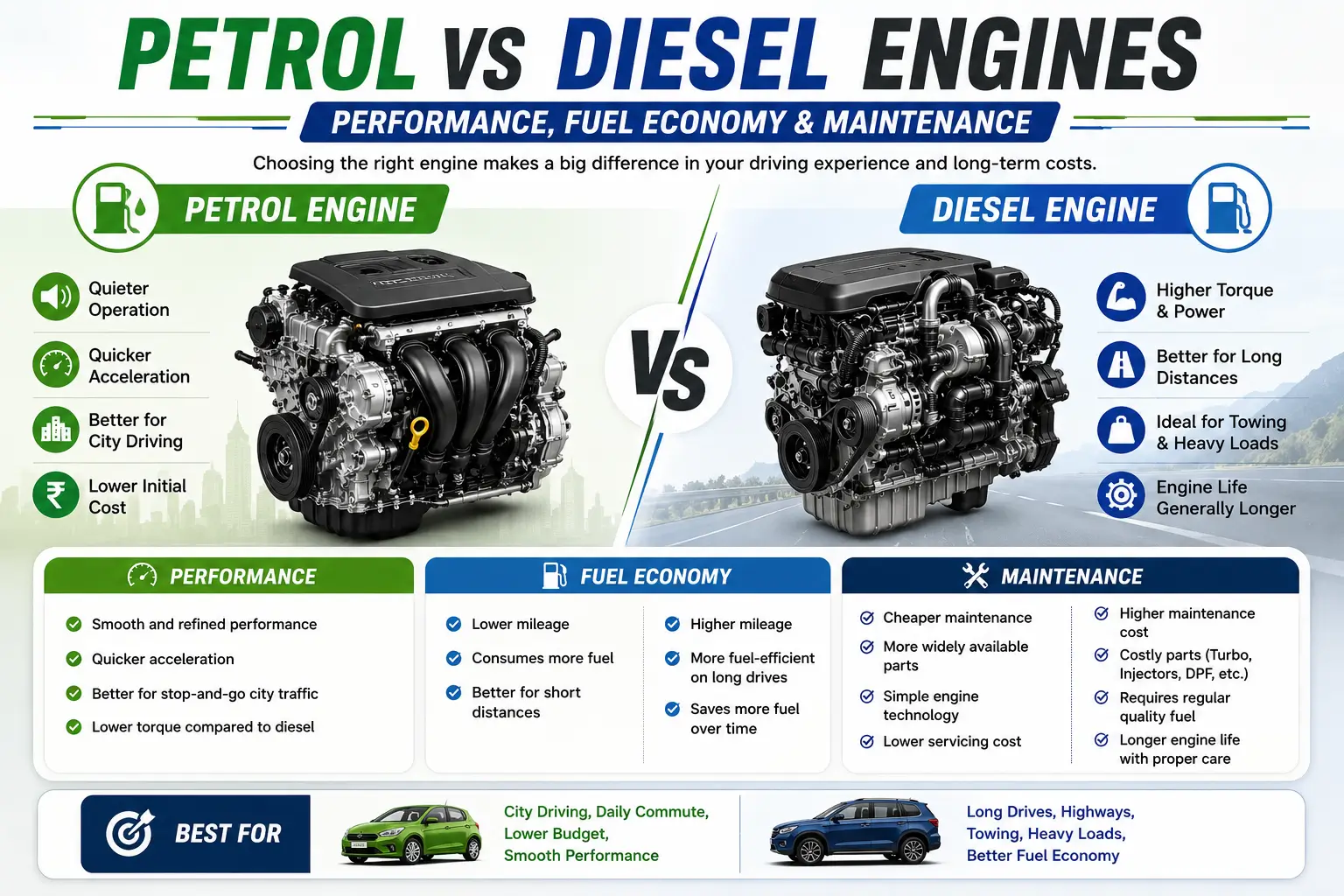
Choosing between a Petrol vs Diesel engine depends on your driving needs, budget, and long-term costs. Petrol engines are known for their smooth performance, quicker acceleration, and quieter operation, making them ideal for city driving and shorter daily trips. Diesel engines, on the other hand,Petrol vs Diesel produce higher torque, making them better for long-distance travel, highway driving, towing, and carrying heavy loads.
A detailed breakdown of how petrol and diesel engines compare on power delivery, running costs, and upkeep — so you can pick the right one based on facts, not assumptions.
Performance
Petrol revs higher & smoother
Fuel Economy
Diesel wins on long distance
Maintenance
Petrol generally cheaper
Choosing between a petrol and a diesel engine is one of the most practical decisions a car buyer makes, and it affects far more than just what you pay at the pump. It shapes how the car feels to drive, how often you visit the workshop, and how much you spend over the years you own it. This guide walks through the three areas that matter most — performance, fuel economy, and maintenance — so the decision is based on how you actually drive, not general opinion.
The Three Things That Actually Matter
P
Performance
Petrol engines deliver quicker acceleration and a smoother driving experience, while diesel engines provide higher torque, making them ideal for heavy loads, long-distance travel, and better pulling power.
F
Fuel Economy
Diesel engines generally offer better fuel economy than petrol engines, making them more cost-effective for long-distance driving and frequent travel, while petrol engines are better suited for shorter daily trips.
M
Maintenance
Petrol engines usually have lower maintenance costs and simpler repairs, while diesel engines require more expensive servicing but often last longer with proper maintenance.
Performance: Power Delivery and Driving Feel
Petrol engines ignite fuel with a spark, which allows them to rev freely and deliver power in a smooth, linear way. This makes petrol-powered cars feel eager and responsive, particularly in the mid-to-high rev range, which is why they are often preferred for spirited or performance-oriented driving.
Diesel engines rely on compression to ignite fuel, producing strong torque at low engine speeds. This gives diesel vehicles a noticeably stronger “pulling” feel from a standstill or at low revs, which is especially useful when accelerating with a full load, towing, or driving uphill. The trade-off is that diesel engines generally cannot rev as high as petrol engines and tend to feel less refined at the top end.
City driving
Petrol engines generally feel more responsive at the low-to-moderate speeds typical of city traffic.
Highway driving
Diesel engines deliver strong, effortless overtaking power thanks to their high torque at cruising speeds.
Towing / heavy loads
Diesel is generally the stronger choice, since low-end torque is exactly what’s needed to move heavy weight.
Engine refinement
Petrol engines are typically quieter and smoother, especially at higher revs and idle.
Petrol vs Diesel Where the Real Savings Happen
Diesel fuel contains more energy per litre than petrol, and diesel engines burn fuel more efficiently under load, which is why diesel vehicles generally return better fuel economy on long, Petrol vs Diesel steady-speed journeys such as highway travel. This advantage becomes especially noticeable over long distances, where fewer fuel stops and lower consumption per kilometre add up to meaningful savings.
Also Read: https://petrolpricepakistan.online/petrol-vs-diesel-cars/
In city driving, however, this gap narrows considerably. Frequent stopping, idling, and low-speed traffic reduce diesel’s efficiency advantage, and the higher upfront cost of a diesel vehicle can take a long time to be recovered through fuel savings if most driving is done in short city trips. Petrol vehicles, by contrast, tend to be more cost-effective for drivers who mostly stay within the city and cover lower annual mileage.
Rule of thumb: the more highway kilometres you drive each year, the stronger the financial case for diesel. The more your driving is short city trips, the more petrol tends to make sense.
Maintenance: What It Costs to Keep Running
Maintenance is one of the most important factors to consider when choosing between a petrol and diesel vehicle. While the purchase price and fuel economy often get the most attention, the long-term cost of keeping a vehicle in good condition can have a significant impact on your overall ownership expenses. Understanding the maintenance requirements of both engine types will help you make a smarter decision based on your budget and driving habits.
Diesel engines use high-pressure fuel injection systems that demand precise, timely servicing. Components such as injectors, fuel filters, and modern emissions systems like diesel particulate filters require careful attention, and repairs to these systems tend to be more expensive than equivalent petrol engine work. On the other hand, diesel engines are often built with heavier-duty internals designed for long-term durability, particularly in vehicles intended for commercial or high-mileage use.
Petrol vs Diesel Differences at a Glance
Choosing between a petrol and diesel vehicle depends on your driving habits, budget, and long-term needs. Petrol engines are known for smoother performance, quieter operation, and lower maintenance costs, making them ideal for city driving and shorter daily trips.
Spark plugs
Required in petrol engines only; not applicable to diesel engines, Petrol vs Diesel which ignite fuel by compression.
Fuel filters
Diesel fuel systems are more sensitive to contamination, so filters typically need closer attention.
Emissions systems
Diesel vehicles often include particulate filters that require periodic cleaning or replacement.
Overall servicing cost
Petrol servicing is generally cheaper; diesel servicing tends to cost more per visit but may be needed less frequently.
Petrol vs Diesel You Actually Pick?
There is no universally “better” engine — only a better fit for your driving pattern. If most of your driving happens within the city, involves short trips, or you simply want lower running and servicing costs, a petrol engine is usually the more practical and economical choice. Petrol vs Diesel If you regularly drive long distances, tow heavy loads, or cover high annual mileage on highways, a diesel engine’s fuel efficiency and torque advantage often justify its higher upfront and servicing costs over time.
Also Read:https://petrolpricepakistan.online/petrol-diesel-price-trends/